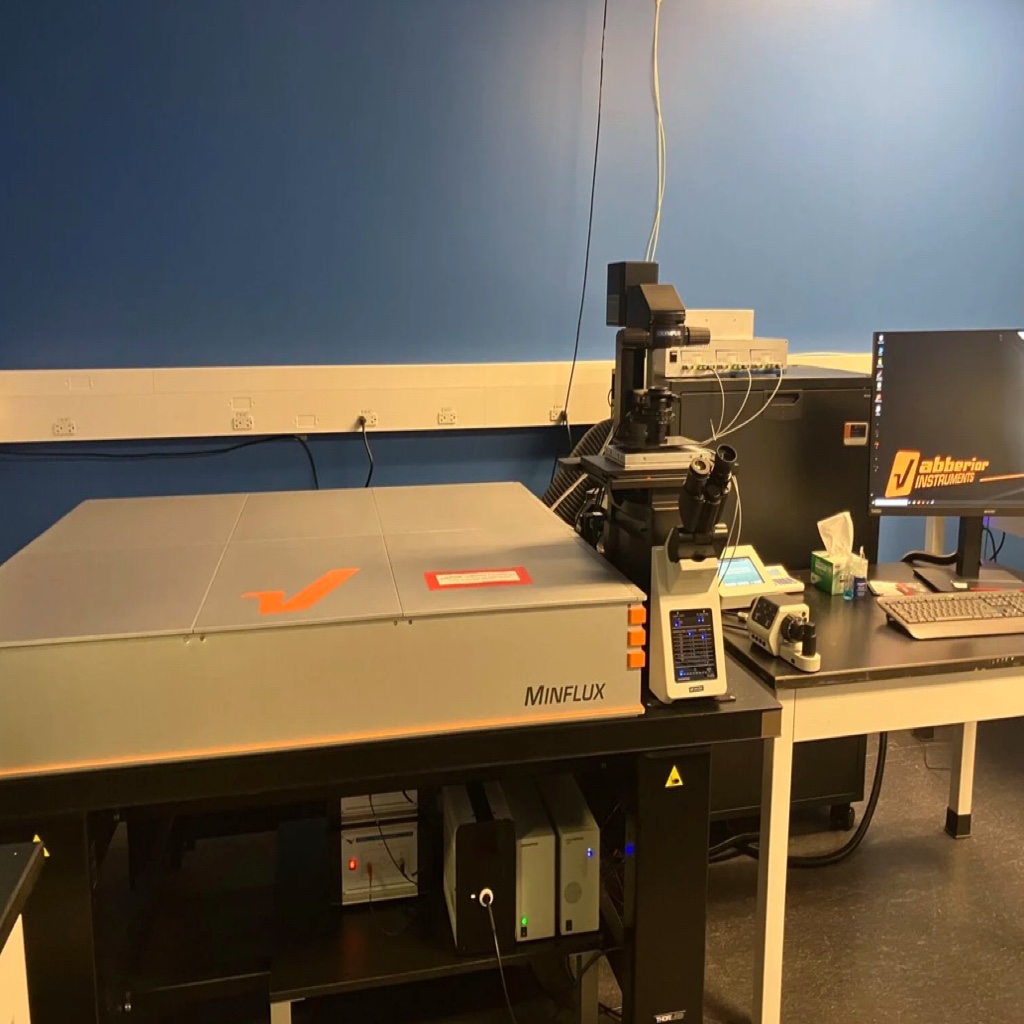
Abberior MINFLUX
Abberior MINFLUX Abberior MINFLUX (2025)
Abberior MINFLUX MINFLUX is a method of imaging that is able to synergistically combine the strengths of STED and PALM/STORM to achieve an unprecedented 3D localization precision of 1-3 nm, and can also be applied to the recording of molecular trajectories with frequencies of up to 10 kHz. In MINFLUX imaging, fluorophores are individually switched in a manner similar to SMLM, allowing for the separation of overlapping signal at a single-molecule level. In turn, the fluorophore localization is accomplished using a movable structured excitation beam featuring a central intensity minimum (zero). Localization is performed by actively targeting the zero of the excitation donut. As the intensity minimum of the excitation beam approaches the fluorophore, there is a corresponding decrease in the emitted fluorescence per unit excitation power, thereby indirectly revealing the residual distance of the molecule to the excitation zero. Through a series of calculated iterations, the excitation minimum is brought as close as possible to the molecule until the detected fluorescence rate matches that of the background noise. At this point, the perfectly controlled position of the zero-excitation intensity becomes a proxy for the position of the emitter. Objectives 100x/1.45 (Minflux, confocal) 40x/0.95 (Widefield, eyepiece) 20x/0.8 (Widefield, eyepiece) Detectors 5x APD: DAPI (422nm – 467nm); GFP (500nm – 550nm); Cy3 (580nm – 630nm); Cy5 Near (650nm – 685nm); Cy5 Far (685nm – 720nm); PMT (Alignment) Lasers Minflux – 640 nm Confocal – 561 nm, 488 nm Activation – 405 nm Acquisition Modes 2D 3D Fast 2D tracking 3D tracking
Similar Instruments
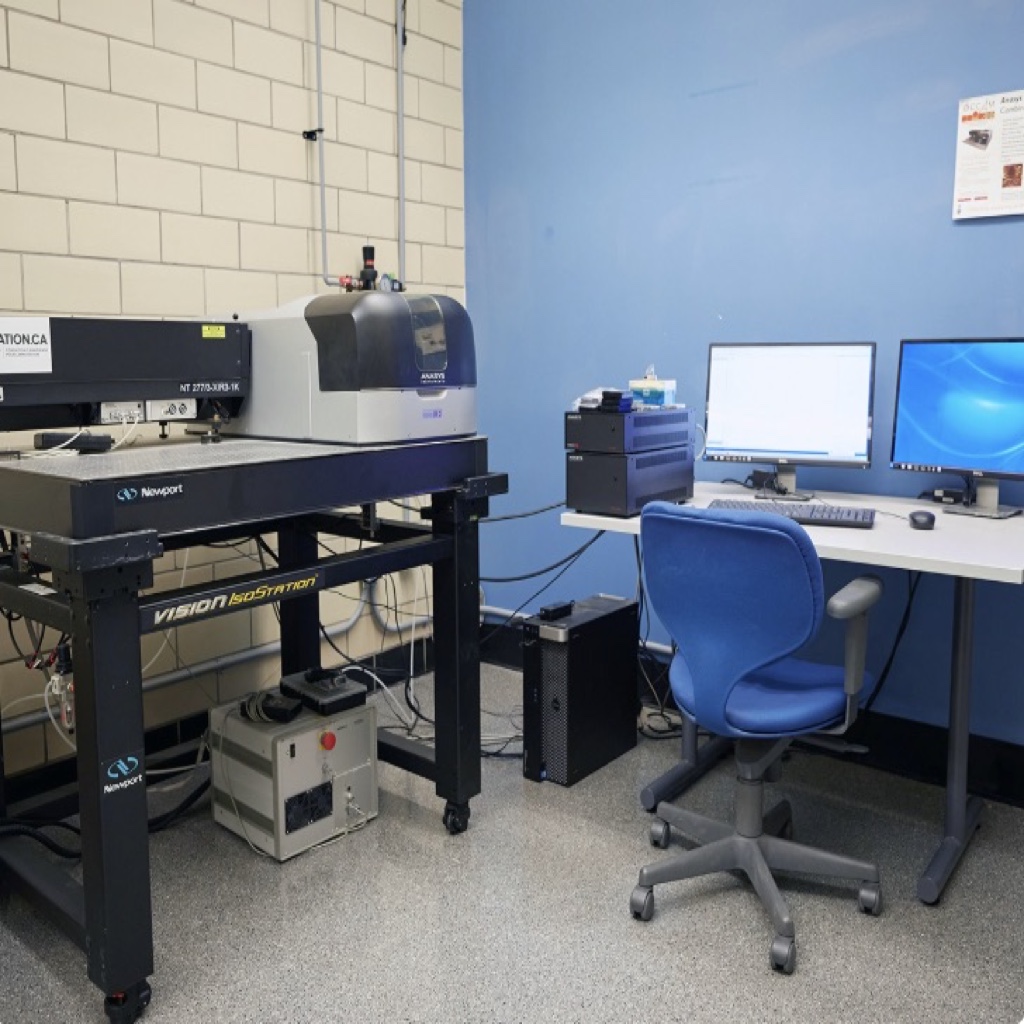
PhotoThermal Infrared Atomic Force Microscope-Anasys Instruments-Bruker nanoIR2
Anasys Instruments-Bruker • nanoIR2