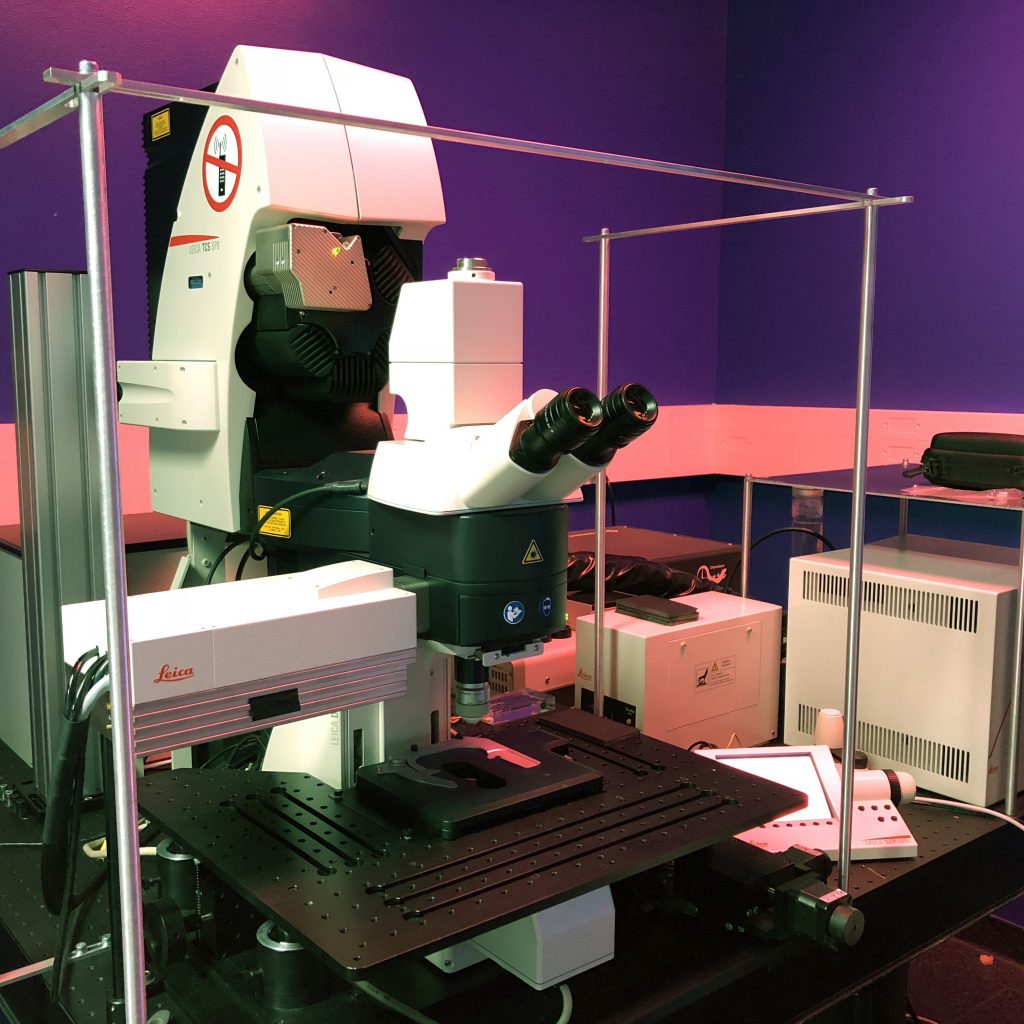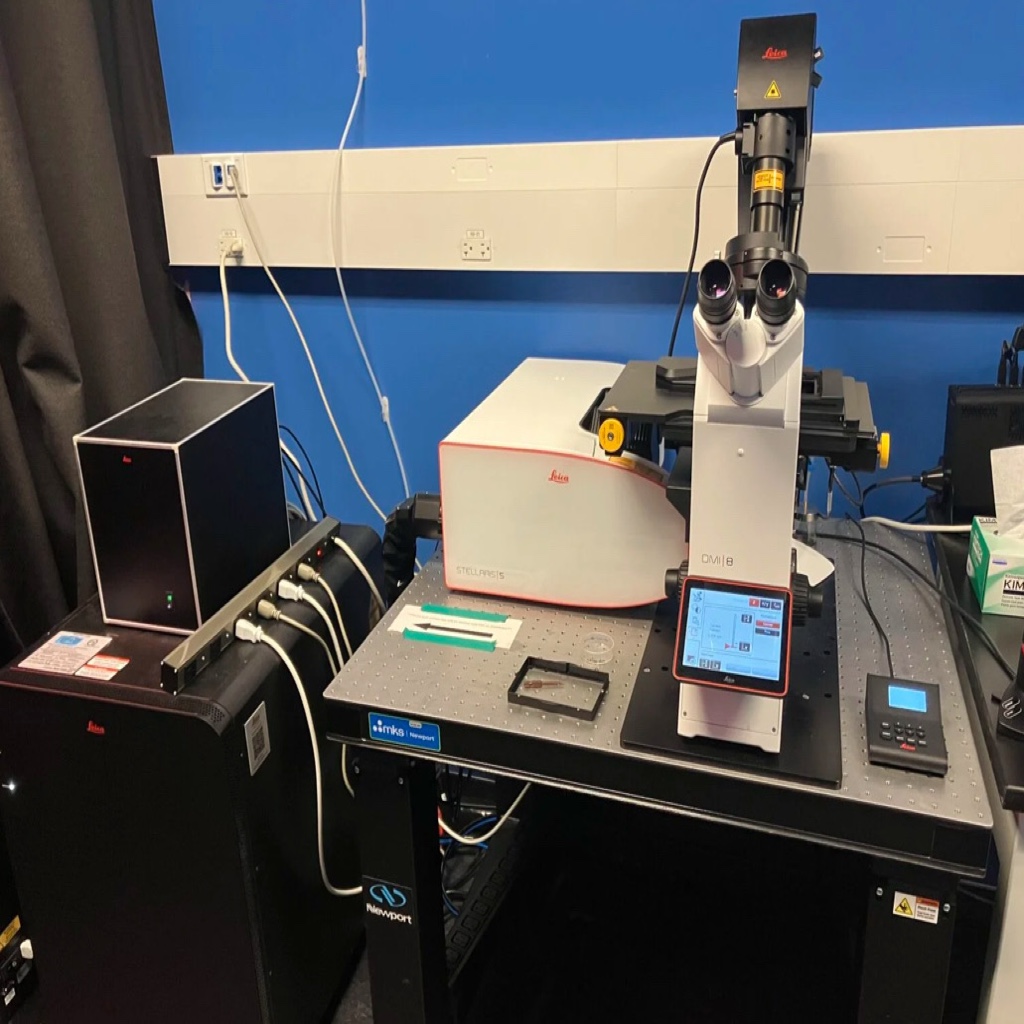
Leica Stellaris 5 WLL
Leica Stellaris 5 WLL Leica Stellaris 5 WLL (2025)
Confocal microscopy is a powerful technique in which a pinhole is used to block out-of-focus light in image formation, thereby generating improved contrast and resolution compared to widefield microscopes. Generally speaking, there are two types of confocal microscopes: point scanning and spinning disk. Although slower than a spinning disk confocal, point scanning confocal microscopes tend to achieve higher resolutions, and have more integrated solutions for specialized techniques such as fluorescence recovery after photobleaching (FRAP). On the other hand, spinning disk confocals tend to have significant advantages in both speed and phototoxicity, making them ideally suited for live cell imaging. In recent years, the resolution of traditional point scanning confocal microscopes has been extended to the super-resolution realm by implementing three key components to a workflow: Closing the pinhole diameter below 1 Airy Unit, Using low-noise, high-sensitivity detectors, Combining pixel oversampling with modern deconvolution algorithms. Taken together, these implementations can improve resolution by up to 40% compared to traditional confocal microscopes, i.e. 120 nm (XY), 400 nm (Z), and can be applied to most standard confocal applications. A specialized application of confocal microscopy is multiphoton imaging. In this technique, a specialized infrared laser is used to selectively excite molecules located within a femtoliter volume of space, up to one millimetre deep within a sample. The primary advantage of multi photon imaging is reduced phytotoxicity and deep sample penetration, making it ideal for intravital microscopy. System name: Leica Stellaris 5 WLL Objectives 5x/0.15 10x/0.4 20x/0.75 40x/1.1 63x/1.4 Lasers 405 nm white light laser (pulsed 485-685 nm) Detectors 4x HyD S Other Resonance scanner (2048 x 2048) Lightning Deconvolution TauContrast